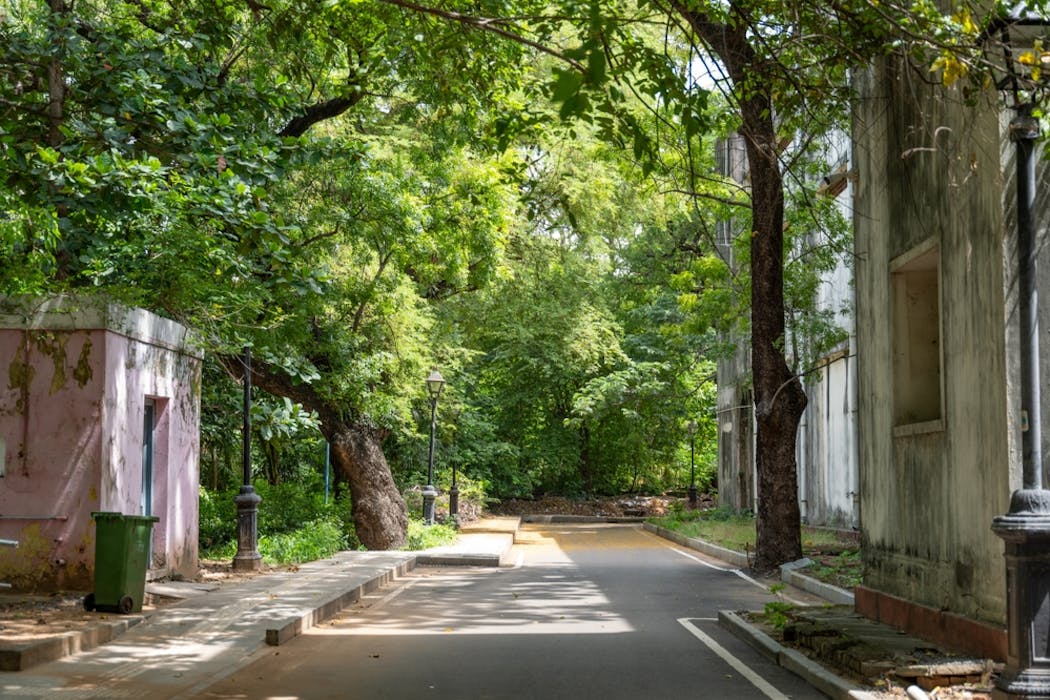
For many years, I lived in the Indian city of Chennai where the summer temperatures can reach up to 44°C. With a population of 4.5 million, this coastal city is humid and hot.
Its suburbs are home to 600 Hindu temples and there’s a wildlife reserve called Guindy national park in the heart of the city. Trees line some of the streets but green parks are few and far between – as is the shade.
As urbanisation accelerates across India and the rest of the developing world, urban forests become more vital. These clusters of trees in parks, gardens, public spaces and along roads and rivers in urban areas have multiple benefits – from cooling the surrounding air to providing homes for wildlife and creating space for people to enjoy nature. Yet they are often overlooked by city developers.
My research shows that, in Chennai, there are 26 square miles of tree and other vegetation cover, mainly accounted for by formal green spaces such as Guindy wildlife reserve. On the outskirts of this city, an area of nine square miles of unused land is ideally suited to creating more urban forest. Similarly, there is more potential space for urban forests in other fast urbanising Indian cities like Coimbatore and Tiruchirapalli.
Global urban planning guidelines recommend having at least 30% tree cover in urban areas. The World Health Organization suggests that cities should allow for nine square metres of urban tree cover per person. Most Indian cities don’t meet this requirement.
Improving urban forests in India has been a challenge for many years due to high land prices, lack of urban planning and little public participation in tree-planting initiatives.
Policies introduced by the Indian government to “green” urban areas often equate tree planting with cooling cities and building climate resilience. But it’s not that simple. The success of urban forests depends on factors such as rainfall, understanding interactions with local wildlife and people’s needs.
A recent study warns that in hot, dry cities with limited water availability like Chennai, trees slow the cooling process by water evaporation from leaves and instead contribute to urban heat. Urban heat comes from the reflection and absorption of sunlight by buildings and land surfaces. This is particularly high in growing smaller Indian cities with populations of 1 to 5 million.
Planting trees with the sole aim of cooling cities could negatively affect wildlife too. Not all birds, bugs and mammals depend on trees for food or shelter. A study from researchers in Bengaluru, India, shows that non-native tree species contribute little to bird richness. Meanwhile, urban grasslands and marshlands that are often misclassified as “waste land” support wildlife and help regulate flooding.
In India, cities and villages have open “common” land where people graze their cattle or harvest fuelwood from trees that grow naturally there – tree-planting initiatives in these open land areas can displace poorer communities of people who rely on open lands for grazing and fuel wood collection.
Read more: Climate change is making cities hotter. Here's how planting trees can help

Design with nature
Urban forests can be planned to meet the needs of people, birds and other wildlife.
In 1969, Ian McHarg, the late Scottish landscape architect and urban planner came up with the concept of “design with nature”, where development has a minimal negative effect on the environment. His idea was to preserve existing natural forests by proposing site suitability assessments. By analysing factors such as rivers and streams, soil type, slope and drainage, McHarg’s approach still helps planners to identify which areas suit development and which are best preserved for nature.
This approach has advanced with new technology. Now, geographic information systems and satellite imagery help planners integrate environmental data and identify suitable areas for planting new trees or conserving urban forests.
Using the principles of landscape ecology, urban planners can design forest patches in a way that enhances the connectivity of green spaces in a city, rather than uniformly planting trees across all open spaces. By designing these “ecological corridors”, trees along roads or canals, for example, can help link fragmented green spaces.
Planting native tree species suited to dry and drought-prone environments is also crucial, as is assessing the local community’s needs for native fruit-bearing trees that provide food.
Read more: India was a tree planting laboratory for 200 years – here are the results
Growing urban forests
By 2030, one-third of India’s electricity demand is expected to come from cooling equipment such as air conditioning. Increasing urban forests could help reduce this need for more energy.
National-level policies could support urban forest expansion across India. In 2014, the government of India released its urban greenery guidelines and flagship urban renewal programmes such as the Smart Cities Mission have tried to increase tree cover. But guidelines often overlook critical considerations like ecological connectivity, native species and local community needs.
In 2020, the government of India launched Nagar Van Yojana (a scheme to improve tree cover in cities) with a budget of around US$94 million (£70 million). It aims to create urban forests through active participation of citizens, government agencies and private companies. But there is little evidence that urban forest cover has improved.
Urbanisation reduced tree cover in most Indian cities, and much of it was rather unplanned. But by protecting and planting more trees, citizens can live in greener, cooler cities. By shifting urban forest policy from counting trees to designing landscapes, plans that enhance climate resilience, nature conservation and social equity can be put into practice.
Don’t have time to read about climate change as much as you’d like?
Get a weekly roundup in your inbox instead. Every Wednesday, The Conversation’s environment editor writes Imagine, a short email that goes a little deeper into just one climate issue. Join the 47,000+ readers who’ve subscribed so far.

Dhanapal Govindarajulu does not work for, consult, own shares in or receive funding from any company or organisation that would benefit from this article, and has disclosed no relevant affiliations beyond their academic appointment.